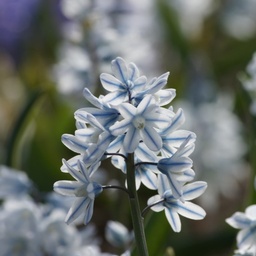
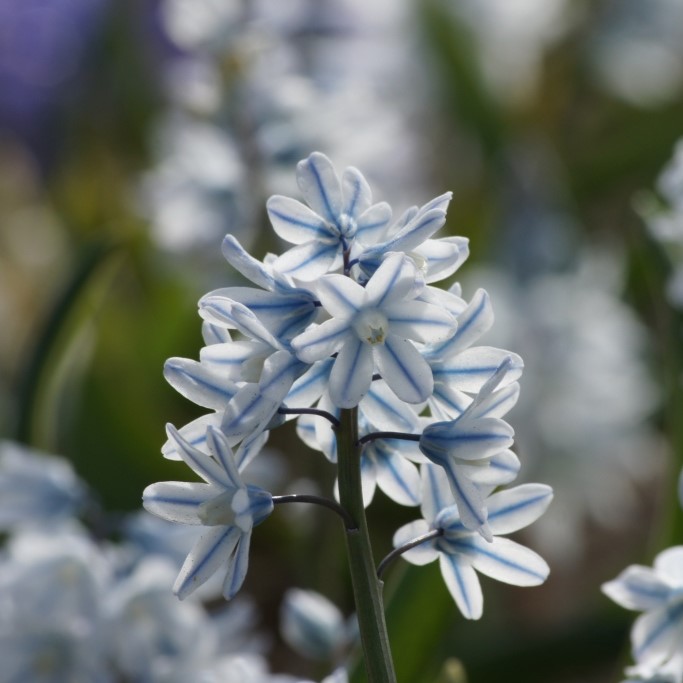
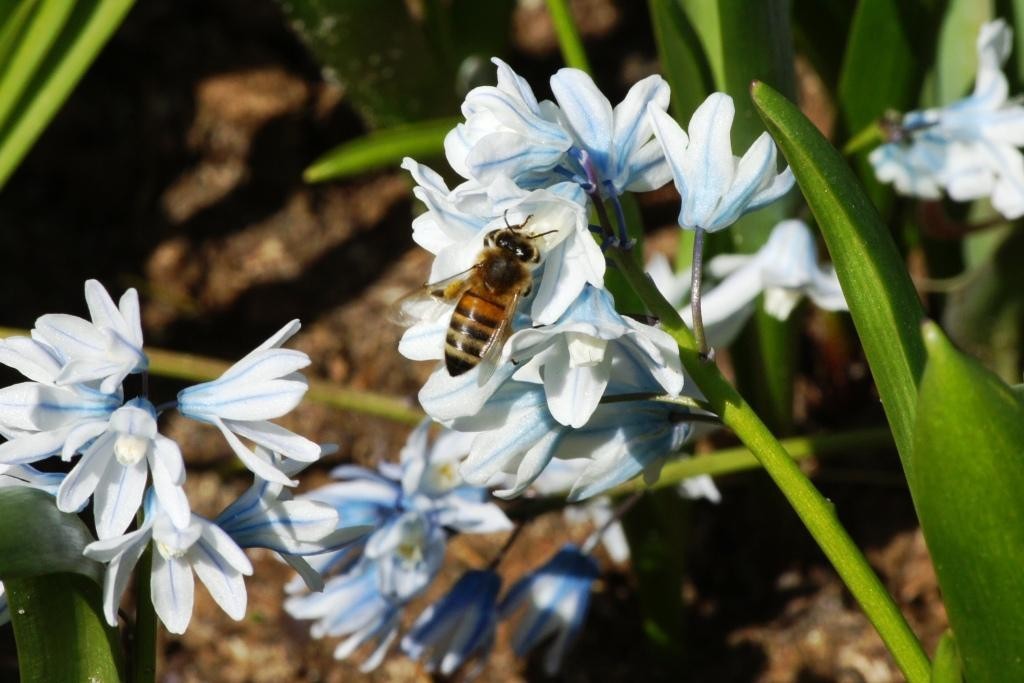
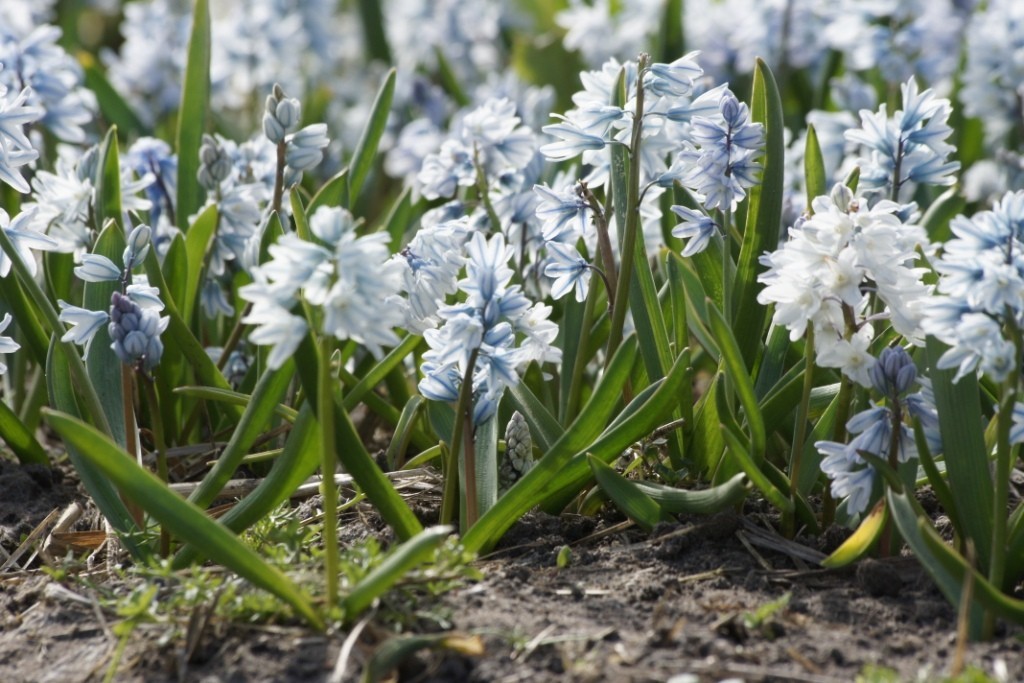
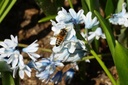
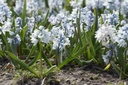
Puschkinia libanotica is a small bulb with a big story. It grows wild in the mountainous regions of the Caucasus, from Lebanon to Iran and beyond — areas with harsh winters and short, intense springs. You can see that background reflected in its character: compact, resilient and flowering at just the right moment. The pale blue flowers, with their fine dark stripe, are delicate to look at, but the plant itself is anything but fragile.
A name to remember
Puschkinia is named after the Russian botanist Apollos Mussin-Pushkin, who collected plants in the Caucasus in the early 19th century. Libanotica refers to Lebanon, where the plant also grows wild. It is a plant with roots — literally and figuratively. In the garden, it behaves like a faithful naturaliser: plant it once, and it takes care of itself. It propagates via seed and bulbils and slowly forms dense, colourful clumps.
Early-flowering and bee-friendly
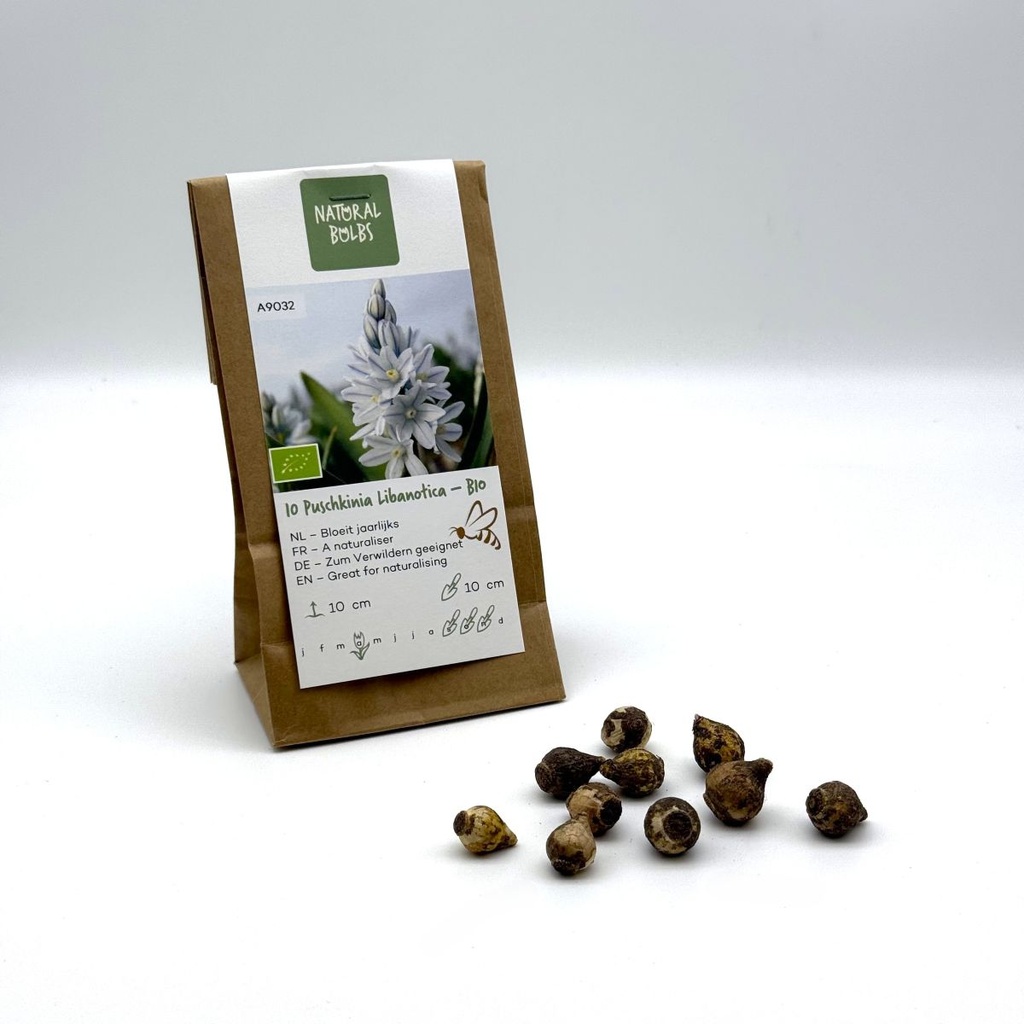
Puschkinia flowers in early spring, at the same time as Scilla and Chionodoxa — and combines beautifully with them. It is a valuable source of nectar for early-season bees. Plant the bulbs in autumn at a depth of about 8 cm, in well-drained, preferably slightly nutrient-rich soil. In full sun or partial shade, amongst the grass or at the foot of a tree — it is not fussy. Organically grown, certified NL-BIO-01.


![[A9011] Ipheion Uniflorum - Spring Starflower - ORG](/web/image/product.template/7370/image_512/%5BA9011%5D%20Ipheion%20Uniflorum%20-%20Spring%20Starflower%20-%20ORG?unique=628efb3)
![[A9043] Puschkinia Libanotica Alba - Striped Squill - ORG](/web/image/product.template/7513/image_512/%5BA9043%5D%20Puschkinia%20Libanotica%20Alba%20-%20Striped%20Squill%20-%20ORG?unique=06fbc46)
![[A9012] Scilla Siberica - Siberian Squill - ORG](/web/image/product.template/7543/image_512/%5BA9012%5D%20Scilla%20Siberica%20-%20Siberian%20Squill%20-%20ORG?unique=b3a79b2)
![[A9050] Triteleia Corrina - Triplet Lily - ORG](/web/image/product.template/7568/image_512/%5BA9050%5D%20Triteleia%20Corrina%20-%20Triplet%20Lily%20-%20ORG%20?unique=fe886a1)