





Mulberry Tree Illinois Everbearing - Royal - ORG
Reference: F1024
A long season of sweet, dark mulberries
- Extended harvest with fruit ripening over many weeks
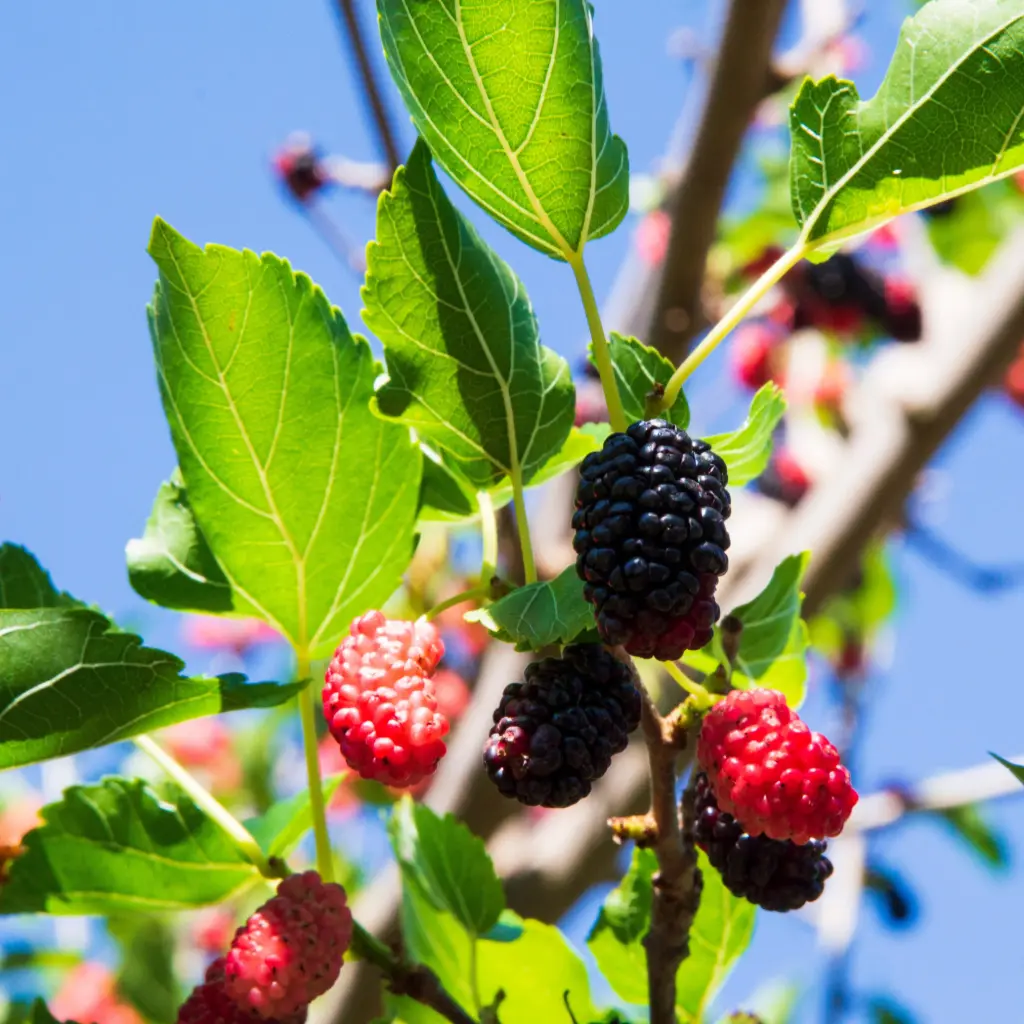
- Elongated reddish-purple to nearly black fruit
- Sweet, juicy and richly flavored with a fresh tart note
- Self-fertile: one tree can produce fruit
- Vigorous fruit tree with a broad spreading canopy
- 100% organically grown
Read more
Features
Order now, delivery within 1-6 working days

Natural Bulbs
-

100% Organic NL-BIO-01
Detail
Illinois Everbearing is a hybrid of Morus alba and Morus rubra prized for one feature in particular: its remarkably long harvest. Instead of ripening all at once, the fruit matures gradually. The elongated mulberries change from red to deep purple and almost black when fully ripe. Their flavor is sweet and juicy with enough acidity to give the fruit a lively, aromatic character. Enjoy them straight from the tree or use them for preserves, juice, desserts and baking.
Does Illinois Everbearing need a pollinator?
No. ‘Illinois Everbearing’ is self-fertile, so a single tree is capable of producing fruit. It is also a vigorous grower, so give it enough room to develop its naturally broad canopy.
How large does Illinois Everbearing grow?
In garden conditions, expect a substantial tree. Around 15 to 20 feet tall is realistic with some management, while mature unpruned specimens can eventually become considerably larger. Choose a sunny location for the best fruit production. Partial shade is tolerated, but plenty of sun helps the crop ripen well. Plant in fertile, humus-rich soil with good drainage. Once established, mulberries tolerate periods of drier weather reasonably well. Avoid planting directly over a patio or pale paving if possible. Fully ripe mulberries are soft, and fallen dark fruit can stain hard surfaces. Your organically grown Illinois Everbearing mulberry is supplied in our Generous container (P15).
When can you harvest Illinois Everbearing mulberries?
Fruit begins ripening during summer, followed by a long succession of additional berries that can continue into late summer or early fall. Harvest when the berries have turned deep purple to nearly black and release easily from the tree. Ripe mulberries are delicate and are best eaten fresh or processed soon after picking.
How do you prune a mulberry tree?
Established mulberries generally need very little pruning. Remove dead, damaged, crossing or crowded branches and allow the tree to develop a strong natural framework. Mulberries can bleed heavily from pruning cuts once sap flow begins. Major pruning is therefore best done after leaf fall in fall to early winter, while the tree is dormant. Avoid repeatedly cutting back large branches simply to keep an unsuitable tree small. Giving the tree adequate space from the beginning produces a healthier, more naturally shaped specimen.
Specifications
| Dimensions | |
|---|---|
| Height | > 500cm |
| Flower size | 1-2 cm |
| Pot size | P15 |
| Ecological | |
|---|---|
| Naturalising | No |
| Perennial | Yes |
| Native to | North America |
| Colour, scent & traits | |
|---|---|
| Colour | Yellow | Green |
| Scented | No |
| Suitable for | Edible parts |
| When | |
|---|---|
| Delivery period | March-May | Sep-Dec |
| Planting season | March - May | September - November |
| Harvest time | July - September |
| Flowering period | 5. Late Spring (May-June) |
| Planting instructions | |
|---|---|
| Prefered location | Sun or partial shade |
| Hardiness | Hardy in most zones |
| Planting distance | 100 cm |
| Planting depth | Pot depth |
| Plant density | 1 per m² |
| Other | |
|---|---|
| Certification | ORGANIC NL-BIO-01 |
| Grower | Koperwiek |
| Group | Moraceae | Fruit |
| Delivered as | Rooted plant in a 15 cm pot |
| Brand | Natural Bulbs |
